Should You Virtually Stage an Empty Bedroom? How Buyers Read Unfurnished Sleeping Spaces
A practical guide to deciding when virtual bedroom staging helps buyers understand a vacant home, and which other rooms deserve the same treatment.
· Sophie
Virtual Staging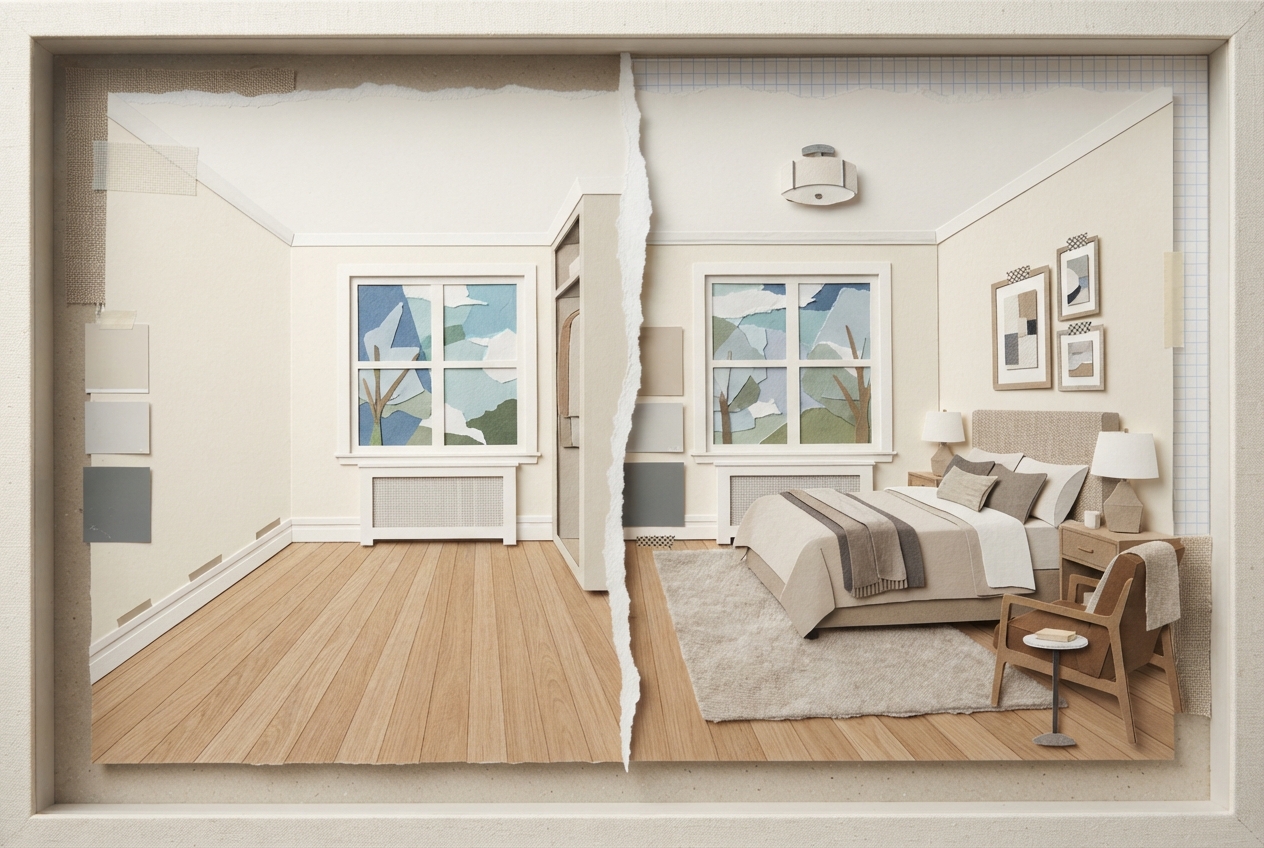
Should I Virtually Stage an Empty Bedroom? How Buyers Read Unfurnished Sleeping Spaces
An empty bedroom is not neutral in a listing. It asks buyers to do extra mental work at the exact moment they are rapidly scanning photos, deciding whether a home feels usable, and comparing it with dozens of other listings. If you are asking, should I virtually stage an empty bedroom, the short answer is yes when the room's purpose, scale, or furniture potential is not obvious from the photo.
Virtual staging is the digital placement of realistic furnishings into a photograph of a vacant room while preserving the actual room's walls, windows, layout, and proportions. Stage an empty bedroom when furnishings will clarify how someone can sleep, work, store belongings, or move through the room. Skip it when the room already reads instantly as a generous, well-lit bedroom and the unstaged image proves that point better.
The decision is less about making every room look decorated and more about removing ambiguity. Buyers do not merely see four walls. They unconsciously ask: Will my bed fit? Is this a true bedroom or an awkward bonus room? Can a child use it? What happens to that empty corner? A well-chosen staged photo answers those questions before the buyer has time to form a doubt.
Why an unfurnished bedroom can read smaller than it is
Furniture is a scale reference. Without it, a 10-by-11-foot bedroom can look either pleasantly flexible or frustratingly tight, depending on lens choice, window placement, and the buyer's own assumptions. Listing photography has a particular problem here: wide-angle images show walls and floor area, but they do not automatically show whether a queen bed, two nightstands, and a dresser can coexist without blocking circulation.
Buyers often fill that blank with caution. They may assume a narrow room only fits a twin bed, mistake a window wall for the only possible bed wall, or read an empty alcove as wasted square footage. This is especially common in secondary bedrooms, converted bedrooms, basement suites, and older homes with less conventional dimensions.
Virtual staging gives the image a human scale. A properly proportioned bed, a rug that leaves visible flooring around its edges, and a nightstand placed where a person could actually reach it do more than add polish. They demonstrate function.
That distinction matters in photo feeds. A buyer does not need to love the throw pillows. They need to understand, almost instantly, that the room accommodates their life. The staged image becomes a small piece of evidence: this room works.
Should you virtually stage an empty bedroom? Use this buyer-perception test
Stage the bedroom if the answer is yes to one or more of these questions:
- Could a buyer reasonably question the room's size? A scaled queen bed can settle the question better than a bare floor plan of walls.
- Is the intended use unclear? A room near a front entry, above a garage, or off a finished basement may be read as an office or flex room unless the listing shows a credible sleeping setup.
- Does the layout have an awkward feature? A sloped ceiling, offset window, shallow nook, or unusual door placement benefits from furniture that demonstrates a workable arrangement.
- Is the likely buyer shopping for bedrooms? Family homes, move-up homes, vacation properties, and student-market properties should help visitors count usable sleeping spaces with confidence.
- Is the room visually cold or disconnected from the rest of the listing? One or two appropriately staged bedrooms can make the sequence of photos feel like a home rather than a set of vacant rooms.
Do not stage purely because the room is empty. A large, rectangular primary bedroom with obvious window and door placement may already communicate its capacity. In that case, an unstaged wide shot can be the strongest proof of square footage, followed by a staged image only if your listing platform and photo strategy support both views.
The most useful question is not, “Would furniture make this prettier?” Ask, “What uncertainty does this photo leave in the buyer's mind?” If there is no meaningful uncertainty, staging may add little.
The bedroom types that benefit most from virtual staging
Small secondary bedrooms
These rooms are the clearest candidates. Buyers tend to inspect secondary bedrooms for the practical realities of children, guests, roommates, and a home office. Stage to the room's most credible use, rather than forcing a luxury primary-suite look onto an 8-by-10-foot space.
A twin or full bed may be the truthful choice. That is not a weakness if it is accurate. A compact desk can show a child-bedroom-plus-homework setup, while a daybed may communicate flexible guest use. What undermines trust is placing a king bed where it cannot plausibly fit, then letting buyers discover the mismatch at a showing.
Bonus rooms and rooms with competing identities
A finished room with a closet may be legally marketed as a bedroom in some contexts, subject to local rules and the property's actual features. Yet visually, buyers might see a media room, office, or storage zone. Staging can establish one primary interpretation and reduce the “What is this?” pause.
Choose the use that aligns with the listing's positioning. For a four-bedroom family home, a believable bedroom setup helps buyers experience the room as sleeping capacity. For a condo aimed at remote-working professionals, an office-bedroom hybrid may be more honest and more useful. The visual should support the way the property is being described, never invent a use the room cannot sustain.
Primary bedrooms with an unusual footprint
An empty primary can look cavernous in photos but still leave buyers unsure how to arrange it. A long, narrow room, a bedroom with two doors, or a space interrupted by a fireplace benefits from an arrangement that protects walking paths and makes the sleeping zone legible.
Here, virtual staging should be restrained. A bed, nightstands, an appropriately sized rug, and perhaps a bench or reading chair are enough. Crowding a room with a vanity, oversized seating, and decorative accessories may obscure the very floor area buyers need to evaluate.
Stage for a believable life, not a showroom
The best virtual bedroom staging makes a buyer feel oriented. It does not ask them to admire a fantasy.
That means furniture placement needs to respect the fixed facts in the photograph: where doors swing, where windows sit, how the light enters, how high the ceiling appears, and how much wall remains after closets and radiators. If a virtual bed blocks a closet, floats at an odd angle, or seems to require walking through a nightstand, buyers may not articulate the flaw. They simply stop trusting the image.
This is where an automated tool needs sound visual judgment built into the output. BetterSpace_2's automatic staging is designed to preserve realistic proportions and layout-accurate placement, so furniture reads as though it belongs in the photographed room. It also avoids a common failure of weaker AI edits: invented windows, altered walls, changed ceiling lines, or lighting that conflicts with the original perspective. Those errors are not minor cosmetic issues. They change what a buyer believes they are evaluating.
For a bedroom image, aim for these visual signals:
- Leave enough exposed floor to show circulation around the bed.
- Match bed size to the room, even when a smaller bed is the truthful choice.
- Place furniture against plausible walls, away from door swings and closet access.
- Let the existing natural light direction govern shadows and brightness.
- Use a design style that supports the home's likely audience without overpowering architectural details.
A staged room should still look like the actual room when a buyer walks in.
Which other vacant rooms should you stage?
Bedrooms are not the only rooms where emptiness creates friction. The highest-priority rooms are generally those where a buyer must understand use, capacity, or connection to another space.
| Vacant room | What buyers may struggle to read | When staging helps most |
|---|---|---|
| Living room | Seating scale and traffic flow | Open plans, narrow rooms, fireplace walls, rooms with multiple entries |
| Dining area | Whether it fits a real table | Eat-in kitchens, open-concept spaces, compact formal dining rooms |
| Primary bedroom | Bed-wall options and overall scale | Long, narrow, angled, or door-heavy layouts |
| Secondary bedroom | Actual sleeping capacity | Smaller rooms, rooms with unusual proportions, family-oriented listings |
| Basement or loft | Whether it is useful living space | Finished flex areas that could otherwise read as leftover square footage |
| Home office | How work fits into the home | Properties marketed to remote workers or rooms that resemble bedrooms |
Kitchens and bathrooms usually need a different judgment call. Their built-in elements already define their purpose, so virtual furniture often adds less clarity than it does in a living room or bedroom. If you are wondering whether staging a bathroom helps sell a house, the answer is usually no for the bathroom itself. Buyers need to inspect the vanity, shower, tile, storage, condition, and natural light. Towels, a bath mat, or minimal accessories can soften a photo, but they rarely resolve a functional question in the way a bed or dining table can.
There are exceptions. A large, empty bathroom with an odd open area may benefit from subtle, proportionate accessories that show a dressing or linen zone. But avoid elaborate virtual renovations, new fixtures, or features that are not present. A bathroom photo has a higher burden of literal accuracy because buyers scrutinize finishes closely.
Use staged and unstaged images strategically in the listing sequence
A virtually staged bedroom does not have to replace every vacant photo. In many cases, the strongest presentation uses both, provided local MLS rules and brokerage policies permit it and the alteration is clearly disclosed wherever required.
Lead with the image that makes the room easiest to understand. For a tiny secondary bedroom, that is often the staged photo. For an oversized primary, an unstaged wide view might establish openness first, followed by a staged image that demonstrates a sensible furniture plan. In listing video, alternate between the actual empty walkthrough view and a polished staged still or visualization only in a way that makes the distinction clear. Buyers should never feel that the home changed between the feed and the showing.
Compliance requirements vary by MLS, state, and brokerage. Check the current rules on labeling virtually staged media, especially when placing furniture changes the apparent use or scale of a room. Clear disclosure protects the buyer experience as much as it protects the listing. It tells viewers that the room is real and vacant, while the furnishing plan is illustrative.
Cost is also straightforward enough to treat as a workflow decision rather than a design project. BetterSpace_2 offers a free plan with one video per month, with paid plans starting at $29 per month, alongside tools for virtual staging and listing video creation. The practical value is speed when a vacant listing needs more visual explanation, not decoration for decoration's sake.
The decision rule for empty bedrooms
Virtually stage an empty bedroom when it helps buyers correctly read the room's purpose, scale, or layout. Do not stage it when the bare photograph already makes those facts obvious, or when the proposed furniture would exaggerate what the room can actually accommodate.
The most persuasive bedroom image is not the most lavish one. It is the one that lets a buyer look at a vacant space and immediately think, “Yes, that works for us.”